Castle of Good Hope
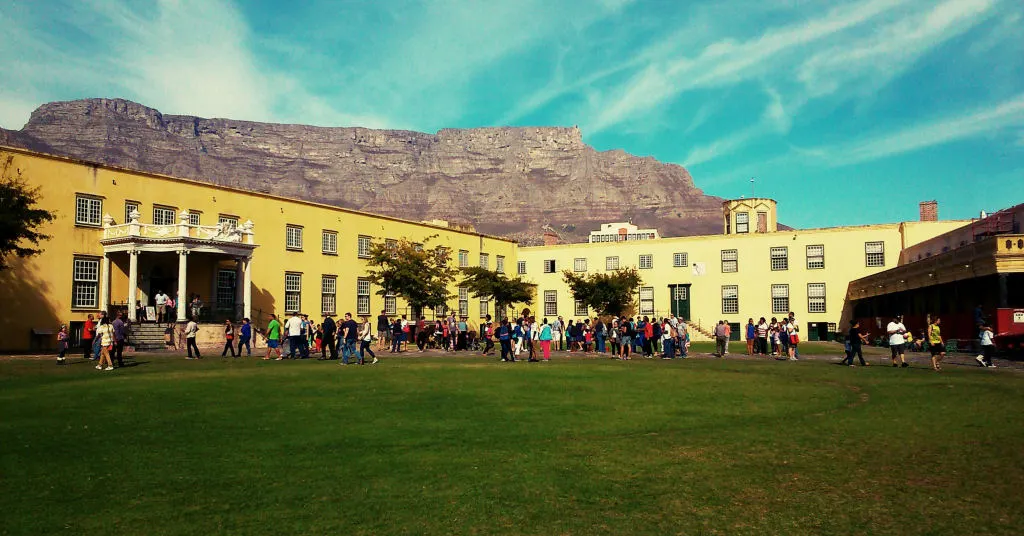
The Castle of Good Hope, located on the edge of Cape Town’s city center, is South Africa’s oldest surviving colonial building and one of the best-preserved 17th-century star forts in the world.
A Brief History
Constructed between 1666 and 1679 by the Dutch East India Company (VOC), the fortress replaced an earlier clay-and-timber fort built by Jan van Riebeeck. Originally situated right on the Table Bay shoreline before land reclamation pushed the ocean back, it served as a vital maritime replenishment station along the Spice Route. Its distinctive pentagonal design features five pointed bastions—Leerdam, Buuren, Katzenellenbogen, Nassau, and Oranje—named after the main titles of William, Prince of Orange. Over three centuries, the complex functioned as the seat of colonial government, a Second Boer War prison, and the regional headquarters for the South African military.
What to See & Do
• The Key Ceremony & Signal Cannon. On weekdays at 10:00 AM (weather permitting), soldiers in historical uniforms reenact the traditional unlocking of the fortress, followed by the firing of the black-powder signal cannon. • De Kat Balcony & Inner Courtyard. Admire the ornate 18th-century balcony where governors once read official proclamations to soldiers, burghers, and enslaved people. Nearby stands the Dolphin Pool, a restored ornamental garden pool, and the Kings of the Castle sculptures honoring indigenous resistance leaders. • Castle Military Museum. Explore displays of historic weaponry, uniforms, medals, and exhibits detailing the site's military past and the 1806 Battle of Blaauwberg. • Iziko William Fehr Collection. Browse 17th- to 19th-century paintings, period furniture, ceramics, and decorative arts depicting early life at the Cape (note: select Iziko gallery spaces undergo periodic restoration, so check status at the gate). • The Dungeons & Torture Chamber. Descend into the cramped, dark cells beneath the walls to see carvings left by 17th- and 18th-century prisoners. • Rampart Walk & Bell Tower. Walk along the yellow-painted stone walls for panoramic views of Table Mountain and the city skyline, and inspect South Africa’s oldest operational bell, cast in Amsterdam in 1697.
Visitor Essentials
• Hours & Admission. Open daily from 09:00 to 16:00 (last ticket sale at 15:15; closed Christmas Day and New Year's Day). Standard tickets are R50 for adults and R25 for children and South African pensioners, with half-price entry on Sundays and free access via the Cape Town City Pass. Check official updates on the Castle of Good Hope website. • Guided Tours. Free guided walking tours typically depart from the main entrance at 11:00, 12:00, and 14:00 and add essential context to the complex's layered history. Plan on spending 90 minutes to 2 hours on-site. • Getting There & Safety. Located at the corner of Castle and Buitenkant Streets opposite the Grand Parade, the entrance is a short walk from Cape Town Station or a quick ride-share drop-off. Because the surrounding Grand Parade and station precinct can be busy and chaotic, use a ride-hailing service or secure parking rather than wandering the perimeter streets with valuables. • Accessibility. Wear comfortable, flat shoes—the historic courtyard and ramparts feature steep stairs and uneven cobblestones that make upper levels and several museum rooms difficult for wheelchair users.
Pairing It With Nearby Stops
The castle sits on the eastern edge of Cape Town’s historic walking route. Combine your visit with the District Six Museum a few blocks south, the Iziko Slave Lodge, and a stroll through the Company's Garden, or grab a quick Cape Malay or Indian lunch nearby at the Eastern Food Bazaar.
A little Africa in your inbox.
Get travel inspiration and marketplace launch news →